

Why this site?
Anyone arriving here may reasonably ask: do you really believe that extraterrestrials would spend years sending letters to people of no importance, instead of approaching the authorities? Don't you know that José Luis Jordán Peña claimed authorship of the whole affair as a "sociological experiment"? Isn't the content of the letters a badly stitched patchwork of science and philosophy we already knew?
We know these objections, and there are good reasons why someone who knows the affair only by hearsay should distrust it. Each of us who maintain this site sees it from their own perspective, but we share two premises:
- We believe that intelligent extraterrestrial life exists and is probably reaching our planet.
- The content of the UMMO letters is exceptional enough for its possible extraterrestrial origin to deserve serious study.
1. Intelligent life visiting us
There is no conclusive proof, but more and more scientists consider that life is not a phenomenon exclusive to the Earth; there is much more caution when it comes to intelligence. Added to that academic discussion is an enormous database of sightings of unidentified flying objects. Most end up being explained as mistakes or hoaxes, but a small percentage, with reliable witnesses and good documentation, describe craft of artificial appearance whose manoeuvres far exceed our technology. The simplest explanation is that they are crewed craft that are not ours.
That explanation runs into two obstacles. The first is physical: our current paradigm makes it almost impossible to cover distances of light-years in times compatible with a human life. A reasonable act of scientific humility, admitting that a more advanced civilization may have found paths we do not yet know, is enough to allow us to keep investigating. The second is more uncomfortable: if they are here, why don't they show themselves openly?
Our own history suggests an answer. When Rome razed Carthage or the Europeans reached America, nobody mourned the loss of those cultures; today, if we discovered an isolated people on a remote island, we would probably protect their isolation and study them without intervening. The more mature a civilization is, the more it protects the others. An official contact with us, as we are, would place a science and a technology centuries or millennia ahead of ours in the hands of those who already concentrate power, and a more mature culture would end up overwhelming ours. It is reasonable to think that this protection is not eternal: a planet that achieves stability, justice and a sufficient understanding of the cosmos will be able to seek contact deliberately. We believe humanity is at an intermediate point, not yet ready as a whole. Showing themselves elusively, without presenting themselves officially, fits that policy: it lets society gradually ask itself the question without imposing the answer on it.
2. Why UMMO is exceptional
The UMMO affair is usually lumped together with the "contactees", but the differences are striking. Most contactees present themselves as chosen ones or ambassadors of the extraterrestrials, and some make a living from it; with UMMO, from the very first letters, there has been what looks like a deliberate effort to prevent anyone from taking on that role. And the content of the contactees' messages is usually a mixture of messianism, good intentions and bargain-basement theosophy, when it is not descriptions of impossible planets. The UMMO letters are something else:
- A human story. They tell how they discovered our planet and about their first days on Earth (D57-1 to D57-5). This is not the story of almost divine beings, but of people more advanced than us. That makes them believable, although it proves nothing.
- A plausible planet. They describe their planetary system, their way of life and their history (D41-1 to D41-16, D74, NR21) with remarkable astrophysical and geological coherence.
- A physics without a prior space. Their basic science rests on the IBOZOO UU (D59-1 to D59-4), primordial elements from whose angular relationships our brain builds the image of space, time and mass. It is a "theory of everything" that does not take the real existence of space for granted, something without precedent in our physics or our philosophy, from Newton to Kant (D78: "“Things”, the objects of my mental process, undoubtedly “are” not as I perceive them"). There is a more detailed study in Analyses & studies.
- A clear and profound philosophy (D75 to D81), with a rich ontology that gives rise to a four-valued logic (NR20) and a theory of knowledge that integrates and goes beyond those of Plato, Aristotle and Kant.
- A vision of the transcendent (D357-2, D731, D792-1, D792-2) so integrated with their physics that it seems inevitable and, at the same time, without parallel in our culture (Teilhard de Chardin perhaps comes close on some points).
- A social organization (D68-1, D68-2) that combines a tiered direct democracy for legislative power, a rigorous selection of executive posts according to each person's aptitudes, and collective ownership of the entire productive apparatus. We invite readers to judge it calmly, beyond the ideological reflexes it arouses.
- A diagnosis of our world (D104, D118, D1378) that speaks not of divine laws or groups of chosen ones, but of a system that raises the most ambitious and unscrupulous to power and keeps much of humanity in poverty, when poverty could be eliminated with a more rational organization.
- A technology ahead of its time. In the 1960s they describe "masks" for space travel with two very high-resolution screens, one for each eye, creating stereoscopic vision (D69-1, note 6): what we now know as virtual-reality headsets. And they propose a sound recorder with no moving parts, based on a cathode-ray tube that prints the signal onto a photosensitive plate (D66).
Testable claims
The letters also contain claims that our science can test, made when nothing supported them:
- Life on Mars. In 1966-67, when the Mariner 4 photographs showed a Moon-like Mars, they claimed to have found single-celled beings and simple multicellular plants there: "You will soon verify this too" (D57-2). We now know that Mars once had liquid water and still holds ice beneath its surface, and in 2025 NASA presented a rock analysed by Perseverance as the best candidate yet for a biosignature. The question remains open.
- An open universe. In 1966 it was not known whether the universe would expand for ever or end up contracting. The Oomen stated categorically that it will expand indefinitely (D41-15), which is what measurements indicate today.
- Pairs of universes. They describe a cosmos made up of infinite pairs of universes with different mass and a different speed of light (D731), an idea that has nothing to do with Everett's parallel universes.
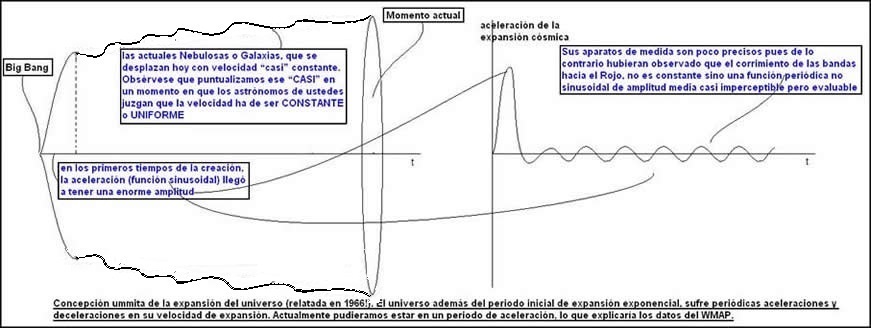
- A non-uniform expansion. This is the most striking claim (D41-15): in the earliest times the acceleration of the expansion "came to have an enormous amplitude", and today the galaxies move with "almost" constant velocity, because the shift towards the red is "a periodic, non-sinusoidal function of almost imperceptible but measurable mean amplitude". In 1966 no model called for anything of the kind. Cosmic inflation, an exponential expansion in a tiny fraction of a second after the origin, was proposed in 1981 (Alan Guth); the present acceleration of the expansion was discovered in 1998; and since 2024 data from the DESI project suggest that dark energy is not constant but varies over time. Whether the acceleration oscillates periodically, as the letters say, remains to be tested; if it were confirmed, it would have been impossible for anyone on Earth to foresee in 1966.
What about Jordán Peña?
Given all this, we cannot simply accept that José Luis Jordán Peña wrote these letters. I had the opportunity to talk to him for a few hours, and when I raised these questions with him my impression was that he simply did not understand what I was talking about.
Since this site was opened the corpus has kept growing: new letters, in Spain and in France, and, more recently, the messages published on X. For all these reasons we believe the UMMO affair is worth returning to. Come in, read the texts, and judge for yourselves.